
HEIRNET 2026 PADOVA CONFERENCE
Wednesday 26th – Friday 28th August
The History Educators International Research Network [HEIRNET] hosts an annual conference which brings together colleagues from all around the world who are interested in history’s civilising, cultural, educational, moral, social, political, and citizenship roles. HEIRNET is a small but friendly informal organisation, and 2026 marks our 22nd year of existence. This year, we are delighted that the University of Padova in Italy is hosting HEIRNET 2026.
Padova (Padua) is a captivating city in Northern Italy’s Veneto region, where medieval cobblestone streets meet the vibrant energy of a modern academic hub. It is perhaps most famous for the University of Padua, founded in 1222, making it one of the oldest and most prestigious institutions in the world. The university has served as a sanctuary of intellectual freedom for centuries, hosting legendary figures such as Galileo Galilei, who taught there, and Nicolaus Copernicus and William Harvey, who studied there.
Beyond its academic prestige, the city is home to the world’s first permanent anatomical theatre and the historic Orto Botanico, the oldest academic botanical garden in existence. This blend of deep-rooted history and the lively presence of its massive student population gives Padova a unique, spirited atmosphere that feels both ancient and perpetually young.
The University of Padova’s 800-year legacy of dedication to the evolution of knowledge and critical inquiry makes it an exceptionally fitting venue for HEIRNET 2026. Founded on the principle of “Libertas” (freedom), the university served as a rare haven where history, science, and philosophy were debated outside the constraints of prevailing dogma. For a conference focused on history education, gathering in a place where Galileo taught and Elena Cornaro Piscopia, the world’s first female PhD graduate, studied provides a profound connection to the roots of academic evidence and pluralism.
THIS YEAR’S THEME: FUTURE TRAJECTORIES IN HISTORY EDUCATION RESEARCH
As education systems across the world wrestle with political polarisation, technological acceleration, and renewed contestation over cultural memory and identity, there is a pressing need to explore the ways in which history education, including teaching and learning and scholarship, can respond to urgent contemporary challenges.
In societies shaped by a multitude of cross-cutting, complex, and sometimes conflicting forces, history education faces renewed questions about its purposes, practices, and public responsibilities. By examining the diverse and wide-ranging trajectories that may shape history education over the coming decades, the 22nd annual HEIRNET conference aims to stimulate dialogue about the field’s future contributions to society. As well as the regular themes (see the website), this year HEIRNET welcomes proposals that interrogate current and emerging research trajectories or demonstrate innovation in scholarship, policy, pedagogy, and public engagement with history. Building on international work exploring historical thinking, historical consciousness, disciplinary knowledge, and the uses of the past, this conference also invites researchers to critically consider how the field might develop across the coming decades.
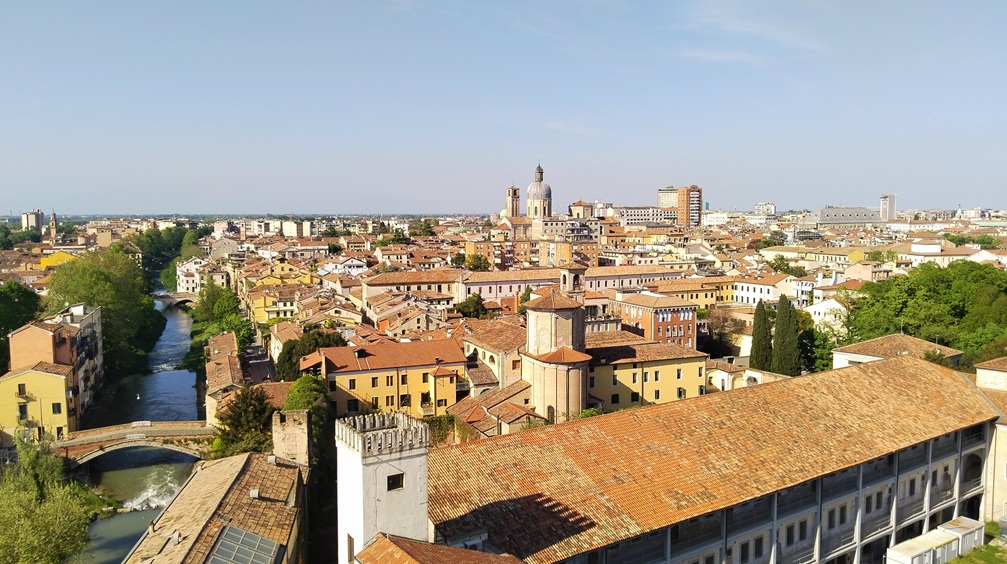
View of the city of Padua, Italy, from atop La Specola museum. By Ricalvo10 – Own work, CC0, https://commons.wikimedia.org/w/index.php?curid=149125933